

Imagine your legs as the locomotor foundation of your kinetic chain; the rectus femoris acts as the central biarticular pillar, governing structural integrity and power output. This complex muscle constitutes a vital component of your quadriceps, uniquely tasked with co-occurring powerful knee extension and essential hip flexion, thereby becoming indispensable for efficient gait and advanced athletic endeavors. Prioritizing targeted rectus femoris exercises is an imperative if you seek profound lower-body structural stability. You must deliberately cultivate tensile strength and optimal elastic resilience in this pivotal muscle to effectively mitigate acute traumatic injury and prevent common quad strain.
Integrating the right rectus femoris exercises fundamentally optimizes your entire lower-body biomechanics, forming a robust barrier against potential tendon tear and dramatically elevating your maximum athletic output.
Rectus Femoris Anatomy: Understanding Your Key Quad Muscle
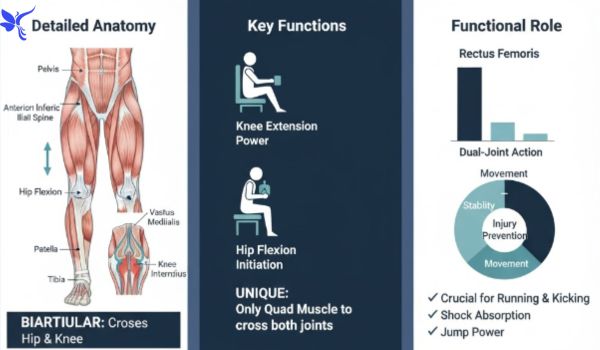
Rectus Femoris Anatomy: What is the Rectus Femoris?
The rectus femoris occupies a distinct and mechanically demanding position among the four quads because it alone successfully bridges both the coxal (hip) and femorotibial (knee) joints. This anatomical singularity makes it fundamentally critical for synchronized, forceful hip flexion—the initiation of the swing phase of gait—and powerful knee extension—the terminal action in kicking. Understanding this demanding dual function is the essential antecedent for selecting truly efficacious rectus femoris exercises that target its entire fiber length precisely. Its origin lies proximally on the pelvis at the anterior inferior iliac spine (AIIS). It then inserts distally, via the conjoined quadriceps tendon and surrounding the patella (kneecap), into the tibial tuberosity.
This crucial muscle is one of four primary quadriceps components; the others are the vastus medialis, vastus lateralis, and vastus intermedius. The key functional distinction is that the vasti muscles are monoarticular, crossing only the knee joint. The rectus femoris is therefore uniquely classified as a biarticular muscle. Its high-demand, double-action role is precisely why it is statistically prone to quad strain during activities demanding high angular velocity, such as competitive kicking or maximal-effort sprinting. When you work to specifically strengthen the rectus femoris, you are intrinsically enhancing both your single-leg power and lower-body joint stability. This specific focus guides the selection of the most effective Rectus Femoris Exercises.
Rectus Femoris Injuries: Causes, Symptoms, and Prevention
The most prevalent clinical affliction of this powerful muscle is an acute muscular quad strain, representing a sudden disruption of muscle fibers that frequently occurs when the muscle is eccentrically lengthened while simultaneously being asked to maximally contract. These rectus femoris injuries occur regularly in competitive sports requiring explosive, rapid acceleration or abrupt changes in the vector of movement. You may feel a debilitating, sharp rectus femoris pain—often described as a sudden impact or tear—in your thigh muscles. This immediate, intense discomfort serves as an unequivocal clinical warning sign, underscoring the necessity of preventative Rectus Femoris Exercises.
What are the discernible symptoms of weakness or chronic pathology? You might observe immediate localized swelling, ecchymosis (bruising), or even detect a palpable fascial or muscular gap following a severe tendon tear. For a less severe condition, subtle rectus femoris weakness may present as persistent referred pain, patellar instability, or obvious compensation patterns during high-speed running. The primary mechanism of injury involves attempting to rapidly accelerate or eccentrically control velocity with the knee extended and the hip simultaneously flexed. A profound pre-existing muscle imbalance between the powerful anterior quads and the weaker posterior chain muscles—the hamstrings and glutes—significantly elevates this injury susceptibility. This emphatically validates the necessity for balanced rectus femoris exercises integrated within a complete posterior-chain development protocol.
5 Best Rectus Femoris Exercises for Strengthening and Injury Prevention
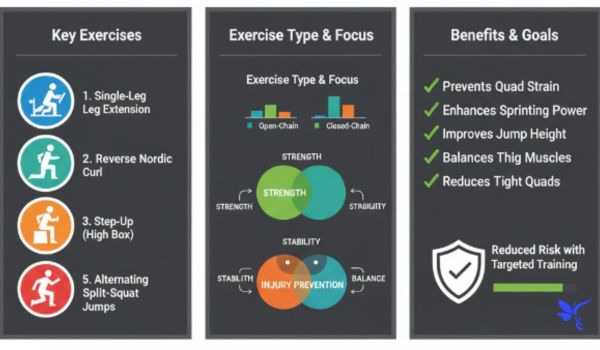
How does one strategically strengthen the rectus femoris for maximal athletic transference? The muscle generates the highest force when subjected to resistance that necessitates simultaneous challenges to both its hip flexion and terminal knee extension function. You should employ a methodical mixture of both single-joint exercises and compound multijoint exercises. This layered training methodology ensures complete muscular development and profoundly reinforces efficient neuromuscular connections. Movements are typically categorized as open-chain (where the distal segment, the foot, is unrestrained, such as the Single-Leg Leg Extension) or closed-chain (where the distal segment is fixed against resistance, such as a high-box step-up). Mastering these distinctions is key to designing effective Rectus Femoris Exercises.
The following table meticulously outlines five uniquely effective rectus femoris exercises. These are specifically chosen to cover the full spectrum of movement types—from pure isolation to high-velocity dynamics—thereby maximizing both raw contractile strength and functional athletic benefit. Integrating these specific techniques is paramount for successful rehabilitation and for forging resilient, powerful quads. Always remember that movement mastery and control are functionally superior metrics to the simple volumetric quantity of weight lifted.
| Exercises | Exercise Description & Benefit | Type |
| Rectus Femoris Exercises #1: Single-Leg Leg Extension | Focus on absolute isolation and controlled, sustained terminal knee extension (TKE), ensuring peak VMO activation and complete fiber recruitment. | Open-Chain (Isolation) |
| Rectus Femoris Exercises #2: Reverse Nordic Curl | Superior for eccentric strengthening and injury prevention, perfect for training the muscle’s powerful braking capacity during deceleration. | Closed-Chain (Eccentric) |
| Rectus Femoris Exercises #3: Step-Ups (High Box) | Highly functional closed-chain workouts that build crucial single-leg strength and dynamic stability, essential for efficient running and climbing. | Closed-Chain (Functional) |
| Rectus Femoris Exercises #4: Straight Leg Raise (against resistance) | Fundamental hip flexion strength, extremely valuable for early rehab and selectively activating the superior portion of the rec fem attachment near the pelvis. | Open-Chain (Rehab/Strength) |
| Rectus Femoris Exercises #5: Alternating Split-Squat Jumps | Advanced dynamic exercises utilizing plyometric force, vital for developing explosive, resilient athletic capability required for sprinting. | Closed-Chain (Dynamic) |
Managing Rectus Femoris Tightness and Pain
It is extremely common to experience persistent rectus femoris pain or the feeling of unrelenting tight quads following intense eccentric training or, conversely, due to prolonged sedentary postures. This chronic discomfort often manifests as vague anterior thigh pain, frequently localizing just above the patella or deep within the hip crease. What truly constitutes the etiology of rectus femoris tightness? Fundamentally, it exists as an overworked muscle that constantly attempts to initiate hip movement or stabilize the knee joint, thereby acting in habitual compensation for inhibited glutes or an insufficiently trained deep psoas muscle (iliacus). If your stabilizing hip thigh muscles fail to execute their primary role, your rectus femoris is forced to carry the systemic mechanical overload. Addressing this imbalance is precisely why therapeutic Rectus Femoris Exercises are essential.
A common but deeply flawed intervention is the immediate pursuit of aggressive, maximal static stretching. You should stringently avoid passive stretching if there is any suspicion of an acute quad strain or documented severe muscle weakness. This action can potentially compromise capsular stability if the muscle lacks adequate motor control or strength at that newly achieved length. The superior approach requires mobility training that purposefully includes active ramping and conscious dissociation (movement pattern) control in the end range. The overarching therapeutic goal is to effectively recalibrate the muscle’s sensorimotor programming and teach the central nervous system (via optimized neuromuscular connections) that the increased muscular length is both safe and strong. This sophisticated approach, which complements strengthening routines, represents a fundamental leap toward a sustainable knee pain solution achieved through balanced Rectus Femoris Exercises.
Effective Techniques for Loosening a Tight Rectus Femoris
How do you loosen super tight quads?
The ultimate key to effectively reducing deep muscular tension is often not aggressively elongating the rectus femoris itself but rather robustly activating its functional antagonists. You should initiate this process with slow, deliberate rectus femoris massage using a foam roller or specialized ball. This form of active self-myofascial release (ASMR), where you actively contract and relax the target muscle while rolling, provides superior rehabilitation outcomes compared to simple passive rolling. Immediately follow this focused tissue release by performing movements that force the muscle’s synergistic neighbors—specifically the glutes and hamstrings—to fire powerfully. This critical step shifts the mechanical and neural workload, teaching the strained rec fem to efficiently downregulate and relax. Incorporating these mobility drills alongside strengthening routines forms a complete approach to Rectus Femoris Exercises.
How do you reliably and quickly relieve rectus femoris pain? For sudden, acute onset pain, the R.I.C.E. protocol (Rest, Ice, Compression, Elevation) should be immediately applied. For persistent, chronic tightness, your strategy must pivot toward active rehabilitation and controlled mobility. These specific, therapeutic movements are expertly designed to dismantle the underlying compensation patterns that perpetuated the tight quads in the first place.
| Exercise Focus | Simple Rectus Femoris Exercises for Tight Quads | Key Semantic Benefit |
| Balance | Glute & Hamstring Activation (e.g., Bridge) | Directly addresses muscle imbalance and reduces the over-reliance on the quadriceps. |
| Synergy | Standing Slumpy Psoas Activator | Trains the true deep hip flexor (psoas muscle and iliacus), thereby allowing the rectus femoris to functionally inhibit. |
| Neural | Extended Knee Ankle Fl-Ex | Mobilizes the femoral and sciatic nerve pathways, a technique shown to reduce the perception of generalized tightness. |
| Control | Ramping (Muscle Contraction) | Uses light resistance to gradually increase and decrease tension, improving conscious motor control and safety throughout the range of motion. |
| Integration | Dissociation (Movement Pattern) | Specifically breaks up harmful habitual movement patterns to improve isolated muscle recruitment patterns. |
Advanced Dynamic Rectus Femoris Workouts
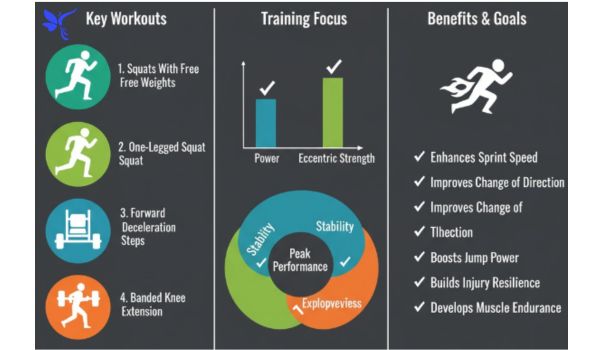
For the competitive or high-level athlete, simply strengthening the rectus femoris through isolated movements is insufficient; you must train it to perform dynamically under maximal eccentric and concentric forces. This necessity demands the application of high loads and velocity during powerful closed-chain workouts. These advanced dynamic exercises serve as the crucial functional bridge that transforms a successfully rehabilitated muscle into a resilient, athletic asset. They strategically target two things: the development of powerful concentric acceleration and the maximization of the muscle’s capacity for controlled eccentric strengthening during rapid deceleration, making them the ultimate Rectus Femoris Exercises.
Closed-Chain Rectus Femoris Workouts:
Squats With Free Weights or specialized loads are the foundational strength movements. However, you must specifically prioritize achieving adequate depth and maintaining a precise tempo to maximally challenge the Vastus Medialis Oblique (VMO) and the rectus femoris complex effectively. Moving to unilateral training, the One-Legged Squat (or Pistol Squat Prep) represents the gold standard for challenging deep, single-leg stability and functional strength. A non-negotiable exercise for runners and team sport athletes is Forward Deceleration Steps. This is paramount for injury prevention, as it teaches the muscle to absorb, control, and reverse high momentum during an abrupt stoppage. Finally, utilizing a lightweight resistance band for the Knee Extension Exercise With Elastic Bands can be highly effective for generating localized metabolic stress and achieving superior muscle endurance through high repetitions, completing your comprehensive range of advanced Rectus Femoris Exercises.
Conclusion: Your Roadmap to a Stronger, Healthier Rectus Femoris
You now possess the most comprehensive, evidence-based roadmap available for achieving a genuinely powerful and resilient lower body. Remember that the unique biarticular function of the rectus femoris mandates targeted rectus femoris exercises that successfully integrate both hip and knee movement simultaneously. Your ultimate success lies in consistently balancing dedicated strengthening (with critical moves like the Reverse Nordic Curl and Single-Leg Leg Extension) and sophisticated dynamic mobility (using Active self-myofascial release and Glute & Hamstring Activation). Never again allow a tight, weak, or overworked muscle to become your systemic point of failure. Consistently apply these superior techniques to secure your permanent knee pain solution and unlock lasting, dominant stability in your quads.
FAQ
How do you strengthen the rectus femoris?
Use exercises that involve simultaneous hip flexion and knee extension, such as a Single-Leg Leg Extension or high Step-Ups.
What are the symptoms of rectus femoris weakness?
Symptoms include anterior knee pain, difficulty with hip flexion, and subtle instability during running or climbing stairs.
How do you relieve rectus femoris pain?
For acute pain, use R.I.C.E.; for chronic pain, focus on targeted rehabilitation and counter-balancing Glute & Hamstring Activation.
How to loosen a tight rectus femoris?
Focus on gentle mobility, using a foam roller for Active self-myofascial release, and activating the glutes and hamstrings.
What causes rectus femoris tightness?
It is often caused by excessive sitting, overtraining, and muscle imbalance where it compensates for weak psoas muscle or glutes.
How do you loosen super tight quads?
Employ Extended Knee Ankle Fl-Ex (nerve gliding), followed by specific activation drills like the Standing Slumpy Psoas Activator.
What exercises work the rectus femoris muscle?
Effective moves include the Reverse Nordic Curl, high Step-Ups, and isolated machine-based Leg Extension movements.
How to activate the rectus femoris?
Activate it by initiating hip flexion (lifting the thigh) while resisting knee extension, focusing on controlled, slow tension ramping.
What happens when the rectus femoris is weak?
Weakness leads to muscle imbalance, poor hip flexion power, and increased susceptibility to quad strain during dynamic tasks like kicking.
Do leg raises train the rectus femoris?
Yes, Straight Leg Raise movements, especially against resistance band tension, effectively train its hip flexion component.
Do squats build the rectus femoris?
Squats, being primarily multijoint exercises, contribute, but targeted isolation moves like the Leg Extension are better for maximum rectus femoris hypertrophy.
What is the hardest leg exercise?
Many consider the Pistol Squat Prep (one-legged squat) or the eccentric phase of the Reverse Nordic Curl to be among the most challenging rectus femoris exercises.

Muddasir Tahir is the founder and lead researcher at Lifestyle Dominates. With a strong passion for fitness and self-improvement, Muddasir spends his time studying human movement and high-performance habits.
His goal is to provide informational topics that are easy to understand and backed by careful research. Muddasir believes that everyone has the power to improve their lifestyle by mastering the right techniques.
When he isn’t researching new ways to help people dominate their lives, he is dedicated to building a community of like-minded individuals who strive for strength and a better mindset every day.
When someone writes an paragraph he/she retains the image of a user
in his/her mind that how a user can know it. So that’s why this paragraph is perfect.
Thanks!
Thank You for Noticing!
These are in fact enormous ideas in regarding blogging.
You have touched some fastidious points here.
Any way keep up wrinting.
Thank You Very Much. Visit the site for useful content.
I visited several web pages but the audio quality for audio songs existing at this website is really marvelous.
It is always a special feel when we find that people are actually loving us a lot. We are thankful to you and hope you visit site again soon!
Write more, thats all I have to say. Literally, it seems as though you relied on the video to make your point.
You clearly know what youre talking about, why waste your intelligence on just posting videos to
your blog when you could be giving us something enlightening to read?
We’ll be working on it soon! Keep Visiting Our Site!