

The Iliacus Muscle is truly the unsung hero of your lower back pain and hip mobility, yet it often hides in plain sight, causing chronic discomfort. This deep-seated hip flexor is absolutely vital for nearly every movement you make, from simply standing up to executing a sprint. When the Iliacus Muscle( Inner hip muscle ) becomes restricted, it can create frustrating issues like anterior pelvic tilt or mysterious groin pain. Understanding this powerful muscle and its function within the greater iliopsoas group is the essential first step.
You are about to discover why the health of your Iliacus Muscle is paramount to achieving a pain-free fully mobile life. This guide will show you how to diagnose, release, and strengthen this incredible hip flexor.
Understanding the Iliacus Muscle and Its Importance
The Iliacus Muscle is truly a silent powerhouse, crucial for every step you take and for maintaining good posture. This deep-seated hip flexor often escapes notice until it screams in protest, creating misery in your daily life. You need to grasp its core function to finally conquer that nagging hip pain or chronic lower back pain that just won’t quit.
This often-overlooked muscle is a massive player in the grand orchestra of pelvic alignment and overall hip mobility. When this muscle becomes shortened or restricted, it can pull your entire body out of plumb, acting like an anchor holding you back. Learning to cherish and care for this powerful, hidden engine is an essential investment in your physical freedom and for avoiding a postural imbalance.
Anatomy and Function of the Iliacus Muscle
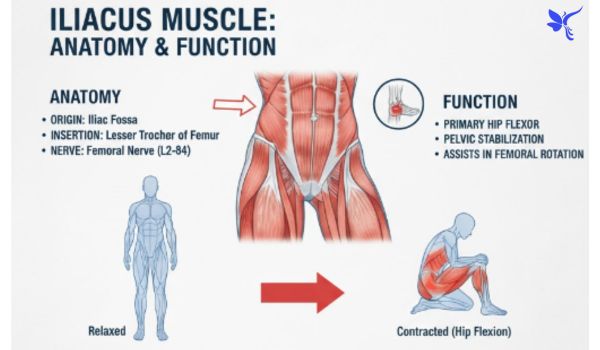
The Iliacus Muscle is tucked away deep inside the pelvis, a beautiful fan-shaped sheet of muscle lining the inner bowl of the iliac fossa. It forms a powerful unit with the psoas muscle, collectively known as the iliopsoas, which is the strongest of the hip flexor group.
Where is the Iliacus Muscle Located?
It originates broadly across the inside surface of the pelvic bone, which is the vast iliac fossa. The muscle then sweeps down and merges with the psoas tendon before inserting subtly onto the lesser trochanter of the femur.
What is the Primary Function of the Iliacus Muscle?
Its most critical job is to flex the hip, which means bringing your thigh closer to your torso. When standing, it acts to stabilize the pelvis and helps prevent you from falling backward.
Why the Iliacus Muscle is Crucial for Hip Mobility and Posture
When the Iliacus Muscle develops muscle shortening due to common sedentary lifestyle effects, it quickly becomes a tight Iliacus Muscle. This chronic shortening pulls the pelvis forward, resulting in an anterior pelvic tilt.
Identifying and Managing Iliacus Muscle Pain
The dull, deep ache of Inner hip muscle Pain can feel like a riddle wrapped in an enigma, making basic movements an absolute chore. This discomfort is typically felt right where your leg meets your torso, often masquerading as a severe groin pain issue. You should know that this misery is your body’s alarm bell telling you something needs attention.
Ignoring this pain is like trying to plug a dike with a small cork; the pressure will only build and cause other joints to suffer. Understanding the culprits, from prolonged sitting to sudden overexertion, is the intellectual first aid that you need to start your journey toward true groin pain relief.
Causes of Iliacus Muscle Pain
Excessive time spent planted in a chair, a signature problem of the modern sedentary lifestyle, is the most likely antagonist leading to a tight Iliacus Muscle. This chronic shortening pulls the pelvis into an anterior pelvic tilt, which then puts the lumbar spine under intense pressure. Athletes, especially those involved in explosive or repetitive hip flexion like dancers and runners, are also prone to developing iliopsoas syndrome.
Common Activities Leading to Tight Iliacus Muscle
Your daily habits can inadvertently sabotage your hip health. Commuting long distances or sitting for eight hours at a computer are primary contributors to a chronic tight Iliacus Muscle and subsequent postural imbalance. This shortening can even affect the nerves, sometimes causing irritation of the femoral nerve.
| Activity | Mechanism of Injury | Resulting Condition |
| Prolonged Sitting | Adaptive muscle shortening | Tight Iliacus Muscle |
| Sprinting/Kicking | Sudden explosive contraction | Hip flexor strain / Iliacus Muscle Tear |
| Repetitive Flexion | Overuse and trigger point formation | Snapping hip syndrome |
Understanding Iliacus Muscle Trigger Points
Inner hip muscle Trigger Points are those vexing, irritable knots that feel like a stone lodged deep within the tissues, radiating pain outward. These specific points are crucial because they can send misleading signals, causing referred pain (to thigh or knee) that is sometimes mistaken for a bladder issue or even deep abdominal pain.
Role of Injury: Iliacus Muscle Tear
A sudden, unexpected lurch or a massive forceful kick can cause the kind of tensile stress that results in an acute Inner hip muscle Tear or a severe hip flexor strain. The resulting sharp agony is usually debilitating, immediately sidelining you from any athletic endeavor. This injury requires immediate rest and professional guidance.
Less Common Causes: Iliacus Muscle Hematoma and Iliacus Muscle Abscess
While very rare, a significant trauma could result in an Iliacus Muscle Hematoma, which is a large collection of blood within the muscle fascia. Even more severe and less common is an Iliacus Muscle Abscess, a collection of pus, usually stemming from a severe infection, which is a surgical emergency. You need quick medical attention for these issues.
Symptoms of Iliacus Muscle Pain
Symptoms range from a nagging, deep ache to restricted movement. A classic sign is difficulty standing straight or needing to walk with a slight forward lean. The pain in hip joint groin area might increase when you try to extend your hip fully.
Differentiating Iliacus Pain from other Hip/Groin Issues
It’s vital to know that true Inner hip muscle Pain is different from conditions like a hip labral tear or a hernia. Iliacus pain tends to worsen with hip flexion or when trying to fully straighten up. You might also experience referred pain (to thigh or knee) that confuses the location of the problem.
When to Seek Medical Attention
If you experience sudden, debilitating pain, have swelling, or cannot bear weight, you must see a healthcare professional immediately. Signs of systemic illness like fever alongside the pain could indicate an Iliacus Muscle Abscess, which is very serious.
Diagnosis of Iliacus Muscle Issues
Pinpointing the exact source of your suffering requires a bit of detective work, as many structures in the hip can simulate Iliacus Muscle distress. A thorough examination helps your healthcare practitioner distinguish between a simple hip flexor strain and a more complex issue like iliopsoas syndrome. You deserve an accurate diagnosis.
Clinical Examination and Assessment
A doctor or physical therapy specialist will perform a series of movements to test your hip mobility and strength. They are looking for specific movement limitations and tenderness deep in the front of your pelvis. This manual therapy assessment is key to ruling out other issues.
Physical Tests to Confirm a Tight Iliacus Muscle
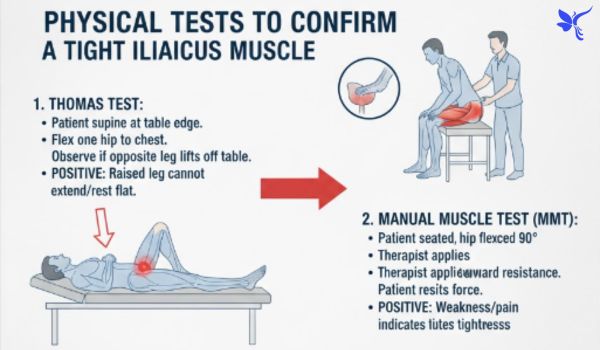
The Thomas Test is a famous physical tool used to reveal if a tight Inner hip muscle or other hip flexor restriction is indeed the principal antagonist. When performed correctly, this test clearly shows the muscle shortening that prevents the thigh from resting flat when the opposite knee is pulled to the chest.
Imaging Techniques for Iliacus Muscle
In more complex situations, especially after trauma or when infection is suspected, advanced imaging may be necessary. For soft tissue injuries like a tear or to assess a persistent hip flexor strain, a specialist may recommend an MRI scan hip for detailed soft tissue images.
Utilizing Iliacus Muscle CT / Iliacus Muscle CT Scan (Imaging Techniques)
A doctor may order an Iliacus Muscle CT or Inner hip muscle CT Scan (Computed Tomography) to rule out serious conditions. This imaging provides detailed cross-sectional views that are superior for detecting calcifications or masses, as well as an Inner hip muscle Hematoma.
Interpreting Iliacus Muscle on CT
Radiologists look for signs of swelling, fluid collection, or changes in muscle density indicative of chronic injury on the images of the Inner hip muscle on CT. This objective data is crucial when distinguishing between a strain and an iliacus muscle abscess.
Effective Strategies for Release Iliacus Muscle
The single most effective path to lasting relief is to learn how to release the Inner hip muscle, granting it the freedom it craves. This liberation involves deliberate, sustained pressure that essentially coaxes the muscle fibers out of their habitual, cramped state. You can absolutely master these self-release techniques.
How to Release the Iliacus Muscle (Step-by-Step Guide)
Releasing a tight muscle is not about fast, aggressive movements; it requires sustained force. The technique is built on finding those tender trigger points and gently applying pressure to initiate myofascial release. This process essentially signals the muscle to relax.
Techniques for How to Release Tight Iliacus Muscle
The simplest and safest technique involves lying on your stomach or back and using your hands or a tool to gently press just inside the bone of your pelvis. You must breathe deeply and hold the pressure for at least 30 seconds to allow the muscle energy technique (MET) to work effectively.
How to Release Iliacus Muscle at Home (Self-Care)
You can achieve excellent results using a tennis ball or a specialized device. Place the tool strategically just inside the front of your hip bone and slowly rest your weight onto it. Remember, the goal is deep, tolerable pressure, not sharp pain.
Using Tools for Iliacus Muscle Release
Since the Iliacus Muscle lies so deep within the pelvis, accessing it can be challenging with just your fingers. Specialized hip flexor release tools provide leverage and allow for precise, sustained pressure that your hands cannot achieve.
Review of the Iliacus Muscle Release Tool / Inner hip muscle Tool
Modern devices designed as an Iliacus Muscle Tool offer various pressure points to target the deep tissues accurately. These tools help you achieve a deep self-release technique more effectively than a simple foam roller technique, which is often too large for this deep muscle.
| Release Method | Depth Penetration | Self-Use Difficulty | Cost | Target Efficacy |
| Tennis Ball | Medium | Low | Low | General Trigger Points |
| Foam Roller | Low | High (Positioning) | Medium | Psoas Muscle (indirect) |
| Specialized Iliacus Tool | High | Medium | High | Direct Iliacus Muscle Myofascial Release |
| Therapist (Manual Therapy) | Highest | N/A | Highest | Precise Muscle Energy Technique (MET) |
Proper Application of the Tool for Maximum Benefit
Always start slowly and use minimal weight when using a release tool. Focus on isolating the painful spots, which are likely trigger points. The key is consistency; use the tool gently for a few minutes daily to achieve the best groin pain relief.
Professional Intervention: Massage Iliacus Muscle
Sometimes, a severely restricted muscle needs the finesse of a professional. A physical therapy for iliopsoas specialist or a skilled manual therapy practitioner can use specific techniques to achieve a faster, deeper release.
Benefits of Deep Tissue Massage Iliacus Muscle
A therapist can accurately locate elusive trigger points and apply sustained, deep pressure that you might not be able to tolerate alone. They often combine this with active movements in a form of myofascial release for superior results.
Finding a Qualified Therapist
Look for professionals who specialize in sports medicine or orthopedic physical therapy. Ask if they are trained in deep tissue work for the iliopsoas muscle or specific manual therapy techniques for the hip.
Stretching Iliacus Muscle for Prevention and Relief
Once the deep tension has been manually addressed, incorporating consistent stretching Iliacus Muscle routines is the essential next step for maintenance and prevention. You must prioritize lengthening this muscle to cement the gains made during the release work and prevent muscle shortening from recurring. This phase moves you from temporary relief to sustainable, improved hip mobility.
Effective stretching complements the prior myofascial release by teaching the muscle to accept a new, optimal resting length, which combats the detrimental sedentary lifestyle effects. This routine is crucial for correcting an anterior pelvic tilt and reducing the associated lower back pain. Remember, a stretching routine should always feel like a gentle pull, not a sharp, painful tearing sensation.
How to Stretch the Iliacus Muscle (Instructional)
Safe stretching posture is vital to truly target the Inner hip muscle without simply hyperextending your lumbar spine. You need to focus on isolating the hip joint itself, ensuring the stretch is felt deep in the front of the hip. This focus is key to achieving true groin pain relief.
Beginner Iliacus Muscle Stretch Exercises
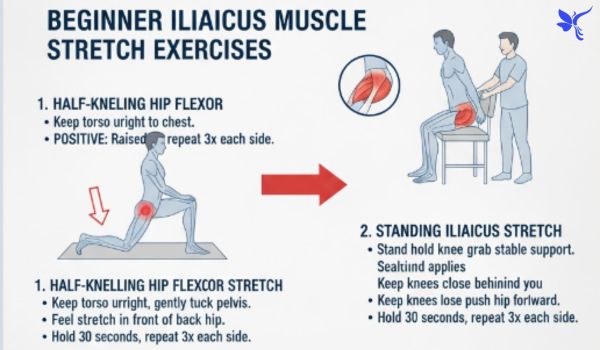
The kneeling hip flexor stretch, one of the most effective psoas stretch variations, is your best friend here. Get into a deep kneeling lunge position, then gently tuck your pelvis under like a frightened cat, performing a slight posterior tilt. This nuanced move prevents you from arching your back and maximizes the stretch in the front of the back leg’s hip.
Advanced Stretches for Deep Release
For those with greater flexibility, or for athletes combating a stubborn tight Iliacus Muscle, you can try using an elevated surface for the back foot to increase the angle of hip extension. These advanced poses require excellent body awareness and are forms of corrective exercise that should only be attempted once basic stretches are mastered comfortably.
Common Mistakes to Avoid When Stretching Iliacus Muscle
The most critical error to avoid is overarching your lower back, which cheats the stretch and can actually aggravate existing lower back pain. Instead, focus intently on that posterior pelvic alignment—a subtle engagement of your abdominal muscles is all you need. This ensures you are truly addressing how to lengthen Inner hip muscle fibers.
Tools to Enhance Stretching
Simple props can serve as fantastic accessories to help deepen the stretch and provide valuable proprioceptive feedback. A stability ball or a sturdy chair can function as an external Iliacus Muscle Stretch Tool to assist in positioning and increase the stretch intensity safely.
Using an Iliacus Muscle Stretch Tool (Equipment)
A piece of equipment like a resistance band can be looped around the back thigh in the kneeling lunge, providing resistance against hip flexion and promoting an active stretch. This type of dynamic stretching routine can improve long-term flexibility and assist with hip mobility.
Safety and Effectiveness Tips
Hold each stretch for at least 30 seconds to allow the tissues to adapt, and never bounce while in the stretch position. Integrating slow, deep breathing is a vital component of any stretching routine, as it relaxes the nervous system and aids in deeper muscle energy technique (MET) principles.
Strengthening and Exercise for Iliacus Muscle (Rehabilitation and Prevention)
A long, relaxed muscle must also be a resilient muscle; therefore, incorporating targeted exercise for Iliacus Muscle strengthening is absolutely vital for long-term hip joint stabilizer function and injury prevention. You cannot skip this step if you desire permanent groin pain relief and freedom from future hip flexor strain.
This phase of rehabilitation is what separates temporary fixes from lasting health, as you transition from mobility to stability, building genuine core strength and control. Strengthening the iliopsoas ensures that once you‘ve achieved great hip mobility, the muscle can handle the loads of everyday life without reverting to a dangerous postural imbalance.
Targeted Exercise for Iliacus Muscle
Focusing on controlled movements and building muscle endurance is the purpose of targeted exercise for Inner hip muscle. A strong muscle is much less susceptible to a future Iliacus Muscle Tear or the development of stubborn trigger points.
Strengthening Exercises to Support the Hip Flexor Group
Controlled, isometric exercises like straight leg raises, or slow, deliberate marching while seated, are powerful ways to build endurance in the entire hip flexor group. This effort transforms a freed Iliacus Muscle into a functioning, dependable asset, essential for proper iliopsoas function.
Stability and Core Work for Long-Term Relief
Since the iliopsoas group, which includes the Iliacus Muscle, acts powerfully as a hip joint stabilizer, strengthening your entire core strength system is critical. Exercises targeting the transverse abdominis and obliques help protect the lumbar spine, ensuring the hip flexors don’t have to overcompensate for lack of core strength.
Integrating Iliacus Health into Daily Life
The best medicine is prevention, so making active movement breaks a daily routine is non-negotiable for you. This conscious effort helps counteract the harmful sedentary lifestyle effects and prevents the recurrence of a tight Iliacus Muscle.
Ergonomic Adjustments for Sitting and Standing
If you must sit for prolonged periods, use a wedge cushion to slightly elevate your hips above your knees, or frequently switch to a standing desk. These small ergonomic adjustments are incredibly effective at keeping the Iliacus Muscle at a healthy, neutral length, minimizing muscle shortening.
Warm-up and Cool-down Routines
Always include a proper warm-up that mobilizes the hips and activates the hip flexor anatomy before any exercise. Crucially, end every workout with a thorough cool-down that incorporates an Iliacus Muscle stretch to prevent immediate tightening.
Summary and Long-Term Outlook
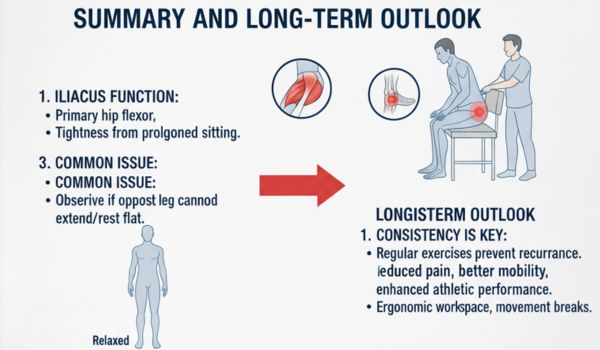
Taking control of your Iliacus Muscle health represents a fantastic commitment to your postural health and freedom from chronic hip flexor pain. You have the knowledge now to manage this powerful deep-seated muscle. Your powerful body is ready to support you when you support it with consistency and informed action.
This comprehensive approach—which includes release, stretching, and strengthening—is the highest level of corrective exercise you can perform. By making these principles a regular part of your life, you eliminate the vicious cycle of pain in hip joint groin area and muscle shortening that holds so many people back from their best physical life.
The Path to Full Recovery
Full recovery from a severely tight Iliacus Muscle requires consistency and patience; you cannot rush the process. Combine the effective self-release techniques with persistent stretching routine and controlled strengthening exercise for Iliacus Muscle to see truly transformative, long-lasting results.
Consistency in Stretching and Strengthening
Emphasize routine over short bursts of intense effort. Even just ten minutes daily of focused manual therapy and stretching will yield far better results than one hour of work once a week. Discipline is the quiet engine of groin pain relief.
Preventing Recurrence of a Tight Iliacus Muscle
Make active breaks a habit, maintain excellent pelvic alignment, and regularly dedicate time to the targeted Iliacus Muscle stretch and strengthening routine. By honoring the needs of your Iliacus Muscle, you ensure a future with greater hip mobility and freedom from debilitating lower back pain.
Conclusion
The journey to mastering your Iliacus Muscle health is one of liberation and strength. By diligently applying the principles of targeted release, therapeutic stretching, and intentional corrective exercise, you actively dismantle the causes of chronic hip flexor pain. Embrace these techniques to restore perfect pelvic alignment, ensuring lasting hip mobility and guarding against future lower back pain. Your commitment to this powerful muscle will undoubtedly unlock a life free from restriction, proving that genuine freedom starts deep within your core.
FAQ (Frequently Asked Questions)
What does iliacus pain feel like?
It often feels like a deep, dull ache in the front of the hip, specifically in the groin area, and may radiate down the thigh.
How do you release the iliacus muscle?
You release the Iliacus Muscle using sustained, deep pressure—often with a specialized release tool or professional manual therapy—to target deep trigger points.
What are the symptoms of a tight psoas and iliacus?
Symptoms include difficulty standing straight, an anterior pelvic tilt, stiffness, and pain in hip joint groin area.
How do you treat iliacus pain?
Treatment involves self-release techniques, gentle stretching routine, strengthening corrective exercise, and avoiding long periods of sitting.
What is the one finger test for sacroiliac pain?
The one finger test is where you can precisely point to the small, specific spot of tenderness over the sacroiliac joint.
How to relieve iliac pain?
Relieve iliac pain through consistent Iliacus Muscle stretch exercises, deep tissue massage, and targeted strengthening exercises.

I am Muddasir Tahir, a dedicated Lifestyle strategist and fitness expert with over 5 years of professional experience. I launched Lifestyle Dominates to serve as your primary source for building mental clarity and physical power. My goal is to give you the tools to improve your daily productivity and overall health. I focus on providing science-backed advice to help you take full control of your modern life.