

Are your shoulders truly bulletproof for heavy lifting or daily activities? Many people focus intensely on the big muscles like the lats and pecs. However, the smaller muscles of the upper back are your secret weapon. You must strengthen the often-overlooked Teres Major and Teres Minor for lasting shoulder stability and movement. Ignoring these muscles is like sailing a ship without a proper rudder, compromising your strength potential. This comprehensive guide will give you the precise knowledge and practical Teres Major and Minor Exercises you need.
This approach will dramatically enhance your upper body strength and help in rotator cuff strengthening. Prepare to unlock the full potential of your upper back muscle function with targeted external rotation drills.
Understanding the Teres Major and Teres Minor Muscles
Mastering Teres Major and Minor Exercises begins with understanding these two critical muscles. You should know that these two muscles are named similarly but have different primary roles. They reside in your posterior shoulder. Knowing their function is crucial for executing the right Teres Major workout and Teres Minor isolation exercises. Understanding the Teres Major and Teres Minor anatomy guides your technique and boosts results.
These muscles are essential components of the glenohumeral joint. The glenohumeral joint is your main shoulder joint. Proper training ensures the humeral head remains centered during movement. This stability prevents wear and tear over time.
Anatomy of the Teres Major: Function and importance in the shoulder and back
When performing Teres Major and Minor Exercises, you must recognize the unique function of each muscle. The Teres Major is a thick, rectangular muscle located just above the latissimus dorsi. It originates from the posterior surface of the scapula. It attaches to the front of the humerus. This muscle is not technically part of the rotator cuff. However, its primary functions closely mirror the lats. It is a powerful assistant in internal rotation of the arm, Humerus extension, and scapular adduction. This Latissimus Dorsi synergy is why pulling movements are key to strengthening the Teres Major. When you perform a row or a chin-up, the Teres Major is deeply involved.
Anatomy of the Teres Minor: Function and importance in the rotator cuff
Conversely, the Teres Minor is a slender muscle situated immediately above the Teres Major. It is a crucial member of the four rotator cuff muscles. It attaches from the shoulder blade to the greater tubercle of the humerus. The major responsibility of this muscle is external rotation drills and stabilizing the head of the humerus. It actively helps maintain the integrity of the shoulder stability during all overhead and pulling motions. The teres minor’s role in the glenoid cavity stability is paramount, acting like a constant anchor for your upper arm bone.
Teres Minor & Teres Major: How To Target These Muscles And Why
To effectively train these muscles, you need to understand their movement patterns. The Teres Major responds best to heavy pulling with a narrow or neutral grip. These grips emphasize the adduction and internal rotation of the arm. To target the Teres Minor, you must use low resistance and focus purely on external rotation drills. Training both ensures powerful pulling capacity and injury-proof stability. A strong body is my greatest instrument, and these muscles are crucial for that. These focused Teres Major and Minor Exercises yield the best results.
Essential Warm-Up and Preparation for Teres Muscle Workouts

You should never skip your warm-up, especially for these sensitive shoulder muscles. A proper routine prevents strains and ensures optimal muscle activation. This preparation is part of Warming up the teres muscles effectively. It makes your entire upper body pulling exercises session safer and more productive.
Think of the warm-up as oiling a complex machine before turning it on. Cold tissues are stiff and prone to tearing. You are preparing your muscles for the specific rotational and pulling demands of the upcoming Teres Major and Minor Exercises.
Warm-Up Techniques for Teres Muscles: Dynamic stretches and light movements
Start with light cardiovascular activity for five minutes to raise your core temperature. Then move into dynamic movements. These increase the blood flow and gradually lengthen the muscle fibers. Focus on gentle, controlled movements; do not force any range of motion. This careful approach helps you avoid injury.
Dynamic Stretches for Teres Muscles
You can use simple exercises to achieve an active stretch. For instance, perform small, controlled arm circles both forward and backward. Another great option is the “band pull-apart” with a very light resistance band. This gently activates the posterior shoulder muscles and begins practicing Scapular adduction. Slowly increase the size of your arm circles as the muscles feel looser. These gentle movements are a perfect introduction to Teres Major and Minor Exercises.
Foam Rolling for Teres Muscles
Myofascial release techniques for the shoulder joint are excellent tools for warm-up or recovery. Use a lacrosse ball or foam roller and press it against a wall. Position the ball on the area just behind your armpit and near your shoulder blade. Roll slowly over tight spots for 30 seconds per side, pausing briefly on any trigger points and referred pain in the teres major. This process improves Teres muscles flexibility before you lift.
Top Exercises for Strengthening Teres Major and Minor Muscles

The exercises listed below are meticulously selected to provide balanced and effective stimulation. You will find movements that engage both muscles at once, and others that isolate one or the other. This balanced approach to Teres Major and Minor Exercises is what builds a truly robust shoulder girdle. Always choose a weight that allows you to maintain perfect form throughout the full range of motion.
Compound Movements Targeting Teres Major and Minor
These exercises are fantastic for building overall mass and strength in the entire upper back.
| Exercise Type | Primary Muscle Focus | Equipment Needed |
| Face Pulls | Teres Major & Minor | Cable Machine / Resistance Band |
| Band Pull Aparts | Teres Major & Minor | Resistance Band |
| Neutral Grip Pull-ups | Teres Major & Minor | Pull-up Bar |
Face Pulls (Teres Major and Minor)
Attach a rope handle to a high cable pulley, positioning the handle just above your head. Step back to create tension. Pull the rope toward your face, externally rotating your hands so your palms face your ears at the end of the movement. This exercise is exceptional for Face Pulls for rotator cuff activation and Shoulder Stability and movement.
Band Pull Aparts (Teres Major and Minor)
Hold a resistance band with an overhand grip, hands roughly shoulder-width apart. Hold your arms straight, separating the band until it makes contact with your chest. Focus on squeezing your shoulder blades together. This highly effective movement builds awareness and endurance in the upper back muscle function. This simple exercise is one of the best Teres Major and Minor Exercises for beginners.
Pull-ups: Neutral Grip or Chin-Ups (Teres Major and Minor)
A neutral (palms facing) or supinated (palms toward you) grip significantly shifts the emphasis from the lats to the Teres Major and biceps. Pull yourself up powerfully until your chest reaches the bar. This is a primary exercise for generating high Scapular adduction force. Use an assisted machine if you are unable to perform bodyweight repetitions.
Supinated Lat Pulldown (Teres Major and Minor)
Grip the bar with a supinated (underhand) grip, keeping your hands slightly narrower than shoulder-width. Lean back slightly, pull the bar to your upper chest, and squeeze your back muscles hard. This Supinated Lat Pulldown grip and technique maximizes the recruitment of the Teres Major due to the enhanced leverage for Humerus extension.
Primary Exercises for Teres Major
These movements place the greatest stress and developmental tension directly onto the Teres Major. They are your go-to options for building back width and thickness. They form the core of effective Teres Major and Minor Exercises.
Single Arm Dumbbell Row (Teres Major)
Rest one knee and hand on a bench. Lift the weight up towards your hip, making sure your elbow stays close to your side. Allow the dumbbell to stretch your back at the bottom. This allows for superior isolation and is a perfect Bent-Over Dumbbell Row targeting Teres Major. The unilateral loading helps fix imbalances.
Cable Pullover (Teres Major and Minor)
Stand facing a high cable pulley and hold a straight bar attachment with an overhand grip. Hinge slightly at the hips, keeping your arms straight with a slight bend in the elbows. Lower the bar in a curving path until your hands are close to your upper legs. Feel the intense Cable Pullover stretch and contraction in your entire back complex. This particular movement is a cornerstone of effective Teres Major and Minor Exercises.
Low Cable Row (Teres Major)
Sit at a cable row machine with a close-grip handle. Pull the weight towards your midsection, emphasizing the retraction of your shoulder blades and keeping your chest high. The lower angle of pull, when performed correctly, provides excellent stimulus and is a top Exercises to relieve teres major pain caused by weakness.
Rear Cable Fly / Reverse Fly (Teres Major)
Set the cable pulleys to shoulder height. Grab the opposite cable handle and step back. Keep a slight bend in your elbows and pull your arms apart until they are fully extended out to your sides. This is a targeted Reverse Dumbbell Fly for posterior deltoid and teres, which boosts detail and separation in the upper back.
Focused Exercises for Teres Minor
You must use very light weight for these moves. The goal is activation and strengthening the rotator cuff strengthening, not lifting a maximal load. This is a critical principle when performing Teres Major and Minor Exercises focused on isolation.
Side-lying External Rotation (Teres Minor)
Lie on your side with the working arm bent 90 degrees and the elbow resting on your ribcage. Hold a light Side-Lying External Rotation with dumbbell (2–5 lbs is plenty). Rotate your forearm upward toward the ceiling without moving your elbow from your side. This movement is the gold standard for isolating the Teres Minor.
Vertical Rotation Exercise (Teres Minor)
Use a resistance band anchored low or a very light cable set at waist height. Hold the handle and stand sideways to the anchor point. Keep your elbow bent 90 degrees and close to your body. Rotate your forearm outward against the resistance. This is an excellent stability drill for the Teres Minor isolation exercises, essential for balanced Teres Major and Minor Exercises.
Post-Workout Stretching and Flexibility for Teres Muscles
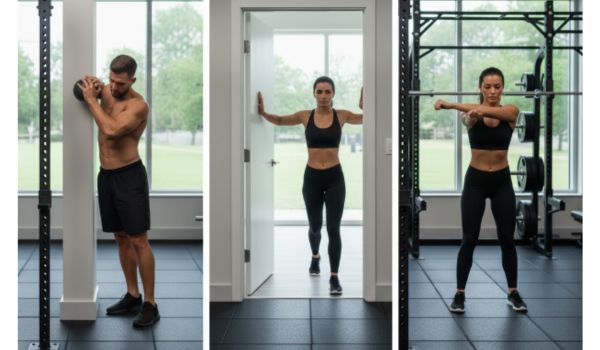
You have just demanded a lot from your posterior shoulder. Now, you must cool down and restore your muscle length. Stretching promotes better circulation and helps maintain Teres muscles flexibility. This is a vital step in your recovery protocol.
Stretching Exercises for Teres Muscles
Incorporating a post-workout stretching routine prevents tightness. It also helps to prevent trigger points and referred pain in the teres major. Hold each stretch for at least 30 seconds to be effective. Do not bounce or overstretch. Always include this vital step after completing your Teres Major and Minor Exercises.
The Doorway Stretch
Stand in a doorway and place your forearms on the frame with your elbows slightly below shoulder height. Step forward gently until you feel a stretch across your chest and the front of your shoulders. This stretch indirectly helps the Teres Major by decompressing the opposing anterior muscles.
The Crossbody Stretch
Bring one arm across your chest, keeping it straight. Gently use your other hand to draw that arm nearer to your torso. You should feel the stretch in the back of your shoulder. This is a great way to target the posterior shoulder and the Teres Minor. Stretching is just as important as the Teres Major and Minor Exercises themselves.
The Sleeper Stretch
Lie on the side of the arm you want to stretch. The arm should be bent 90 degrees at the elbow and raised to shoulder height. Use your non-working hand to gently press your forearm down toward the floor. You will feel this intensely in the Teres Minor and the back of your shoulder. Use this carefully.
Preventing and Managing Teres Muscle Pain
Pain in the Teres Major or Teres Minor can be incredibly debilitating, often presenting as deep shoulder pain or pain radiating down the arm. Prevention is always the best medicine. You must be proactive in your daily life and training regimen. Understanding this is key to successfully performing Teres Major and Minor Exercises.
Preventing Teres Muscle Pain: Key Strategies
A holistic approach is necessary to keep your shoulders happy and healthy. This includes your daily habits, not just your gym routine. This mindset supports all your Teres Major and Minor Exercises.
Maintaining Good Posture
Poor posture, slouching forward while sitting—puts constant, passive stress on the Teres Major and Teres Minor. Imagine a tug-of-war where your chest muscles are always winning. Sit up tall with your shoulders back and down. This maintains the optimal relationship between your scapula and humerus. Good posture enhances the effectiveness of all Teres Major and Minor Exercises.
Gradual Progression in Workouts
Avoid the temptation to increase your training load or volume too quickly. Sudden spikes are a primary cause of tendon and muscle irritation. Increase repetitions or weight by only a small amount each week. This measured approach protects your tissues.
Ergonomic Adjustments for Daily Life
Make sure your computer monitor is at eye level and your keyboard is positioned so your shoulders are relaxed. These Ergonomic adjustments for shoulder stability and posture reduce the static tension that can lead to Trigger points and referred pain in the teres major. Try using a standing desk for some hours each day. Applying these changes will make your Teres Major and Minor Exercises more effective and safer.
Addressing Teres Major Pain and Dealing with Teres Minor Pain

If you experience pain, it is vital to stop the aggravating activity immediately. Teres Major Pain often feels like a deep ache near the armpit or shoulder blade. Teres Minor Pain is usually sharper, felt directly in the back of the shoulder, and worsens with External rotation drills. A physician should be consulted if pain persists or if you suspect a tear (Hornblower’s Sign Test for rotator cuff integrity is a clinical indicator).
Relief Techniques
Once acute pain subsides, gentle relief measures can speed up healing. This critical phase ensures you can safely return to your Teres Major and Minor Exercises.
Recovery Techniques for Teres Muscle Pain
Active recovery, like very light resistance work or low-impact activity, improves blood flow. This fresh blood carries nutrients that aid in tissue repair. Never push through sharp pain, only gentle discomfort.
Myofascial Release (Foam Rolling and other methods)
Revisit the foam rolling techniques, spending more time on tender areas. Use a sustained, gentle pressure. This form of Myofascial release techniques for the shoulder joint can break up knots and increase local circulation.
Ice and Heat Therapy
Alternating between ice and heat can be very effective. Apply ice for 15 minutes to reduce inflammation immediately after an acute flare-up. Switch to heat therapy 24–48 hours later to increase blood flow and promote healing.
Deep Tissue Massage
A professional massage therapist can apply focused pressure to release deeply held tension. This may be uncomfortable, but it is excellent for chronic issues. It can significantly help in Exercises to relieve teres major pain by releasing the surrounding tight muscle groups.
Conclusion
You now possess the in-depth knowledge and an arsenal of the best Teres Major and Minor Exercises available. You understand the critical role of Teres Major and Teres Minor anatomy and function. Do not treat these muscles as an afterthought. Consistently implementing these Teres Major and Minor Exercises and recovery strategies will lead to a stronger, more resilient shoulder stability. Make these movements a priority and watch your overall upper body pulling exercises performance soar.
FAQ
What exercise works the teres major and minor?
Compound movements like Face Pulls and neutral-grip Pull-ups effectively engage both muscles, while Side-Lying External Rotation isolates the teres minor.
What are the symptoms of a damaged teres minor?
Symptoms typically include sharp pain in the back of the shoulder, weakness during arm rotation, and difficulty performing external rotation drills.
How to build teres major muscle at home?
Use resistance bands for Band Pull Aparts, and focus on upper body pulling exercises like towel rows if you do not have access to weights.
How to relieve teres minor pain?
Apply ice therapy, use gentle Crossbody Stretches, and perform very light Teres Minor isolation exercises to encourage blood flow and recovery.
How do you tell if the teres major is torn or pulled?
A tear often presents as sudden, sharp pain, a potential popping sensation, and severe weakness during internal rotation of the arm or adduction.
Can poor posture cause teres minor pain?
Yes, consistently rounded shoulders or poor posture can overstretch the teres minor, leading to strain and trigger points and referred pain in the teres major.

Muddasir Tahir is the founder and lead researcher at Lifestyle Dominates. With a strong passion for fitness and self-improvement, Muddasir spends his time studying human movement and high-performance habits.
His goal is to provide informational topics that are easy to understand and backed by careful research. Muddasir believes that everyone has the power to improve their lifestyle by mastering the right techniques.
When he isn’t researching new ways to help people dominate their lives, he is dedicated to building a community of like-minded individuals who strive for strength and a better mindset every day.